Best NBA Betting Strategy: A UK Bettor’s Complete Playbook for the 2025-26 Season
 Available in US
Table of Contents
- Five Numbers That Frame Every NBA Bet You Place From the UK
- The UK Market Context Every NBA Punter Should Understand
- NBA Bet Types Explained: From Moneyline to Bet Builder
- The Four Foundational Edges That Beat the Market
- Reading the Injury Report and Load Management Calendar
- Why Back-to-Back Games Move the Line by Two Points
- Home Court Advantage: The Asymmetry the Public Misreads
- Closing Line Value and the Habit of Line Shopping
- Bankroll Discipline: The Maths That Outlives a Cold Streak
- In-Play Betting and Streaming: A UK Bettor’s Edge in EU Time Zones
- The Rozier Fallout: How NBA Integrity Probes Are Reshaping Prop Markets
- UK Tax, Licensing and Why You Should Stick to UKGC Books
- Putting It Together: A Repeatable Pre-Game Routine
- Frequently Asked Questions
- Discipline Beats Genius Across an 82-Game Season
Five Numbers That Frame Every NBA Bet You Place From the UK
- UK punters pay zero personal tax on betting winnings – a structural edge reinforced by UKGC consumer protections including 96.3% automatic withdrawal processing.
- Back-to-back teams win just 43.6% of games, losing 2.21 points of net efficiency per 100 possessions. Check the schedule before you check the odds.
- Home court advantage varies wildly: Boston’s TD Garden produces a 0.751 win rate over three seasons while bottom-tier venues barely register an edge. Arena matters more than league average.
- Closing line value – not win rate, is the reliable long-term skill indicator. A consistent half-point from line shopping across UK books translates to hundreds of pounds of yield per season.
- The post-Rozier integrity reset has narrowed player prop markets. Focus prop activity on established starters and multi-stat categories where manipulation is hardest to execute.
I placed my first NBA bet from a flat in Hackney in 2014, hunched over a laptop at half past midnight, squinting at a Lakers-Clippers total I had no business touching. I lost. Not because the pick was wrong (the under hit by six) but because I’d taken it at a UK book that padded the vig so heavily I needed 56% accuracy just to break even. Twelve years later, the lesson still anchors everything I do: the best NBA betting strategy for a UK punter isn’t a magic system or a tipster subscription. It is a repeatable process that puts you on the right side of the maths, night after night, from a timezone that most Americans forget even exists.
The 2025-26 season has delivered record viewership: 170 million viewers in the US alone, the highest in 24 years per the NBA’s own recap. Globally, fans consumed more than 1.3 billion hours of live broadcasts, up 93% year on year. In Britain, basketball jumped seven places to 13th in the EY-Parthenon Sports Engagement Index for 2025, and 6th among Gen-Z adults aged 18 to 24.
NBA viewership in the UK – roughly 7% of British adult internet users watch NBA content, and 77% of all basketball fans in the UK follow the NBA specifically, per Kagan Consumer Insights data. The audience skews young: 57% of UK NBA viewers are under 35, while the over-55 bracket barely registers at 3%.
That growth in interest has not been matched by quality strategy content for UK bettors. Most of what ranks on Google is either an affiliate comparison of welcome offers dressed up as a “guide”, or a US-focused piece that never mentions UKGC licensing, the absence of betting tax or the fact that you’re wagering between 11pm and 3am. This playbook closes that gap: bet types, foundational edges backed by peer-reviewed data, the post-Rozier integrity shake-up, and a pre-game routine you can run in fifteen minutes. Concrete numbers, real scenarios, a framework you can start using tonight.
The UK Market Context Every NBA Punter Should Understand
Three years ago, if you told a UK sportsbook trader that basketball would be the fastest-climbing sport in their engagement data, they’d have laughed and gone back to pricing Premier League corners. Nobody’s laughing now. The money flowing through UK gambling has hit a scale that makes NBA markets viable in a way they simply weren’t a decade ago, and understanding that scale gives you context for every edge discussed in this playbook.
Andrew Rhodes, Chief Executive of the UK Gambling Commission, put it plainly at the BGC Annual General Meeting in March 2025: total gross gambling yield across Great Britain has reached its highest ever level at 15.6 billion pounds, with participation holding steady at 48% of the adult population. For the remote sector specifically, covering online casino, betting and bingo, GGY for the financial year ending March 2025 came in at 7.8 billion pounds, a 13.1% increase year on year, according to the Commission’s Industry Statistics annual report.
Betting is no longer a sideshow. In Wave 2 of the Gambling Survey for Great Britain (April to July 2025), sports betting overtook every other form of gambling except the National Lottery, with 12% adult participation, a 3 percentage point jump from Wave 1. By Wave 3 (July to October 2025), 8% of UK adults had placed an online sports bet in the previous four weeks.
What does this mean for someone betting on NBA games from a sofa in Manchester or Edinburgh? First, the sheer size of the UK market ensures that UKGC-licensed books maintain competitive NBA lines rather than treating basketball as an afterthought. When the revenue pool is this large, operators can afford dedicated basketball traders and tighter pricing, especially during the regular season when a full slate of games runs almost every night. Second, the regulatory framework provides consumer protections (fund segregation, withdrawal standards, dispute resolution) that offshore books simply do not offer. I’ll come back to that in the UK bookmakers for NBA section, but the short version is that betting within UKGC-licensed operators is not just safer; it’s strategically smarter.
Sky Sports NBA viewership in the UK has climbed roughly 40% since 2019, with the steepest increase among viewers under 30, the same demographic that is most likely to combine watching with betting.

The structural tailwind is clear. More UK money flows into sports betting than ever before, basketball is the rising sport among the demographic that bets most, and the regulatory envelope keeps tightening in ways that benefit informed punters. The question is whether you’ll ride that wave with a system or get swept under it by vig and impulse.
NBA Bet Types Explained: From Moneyline to Bet Builder
My first year betting NBA, I treated every market the same way: chuck a fiver on whatever looked interesting and hope for the best. That approach has a name in the industry: it’s called donating. NBA markets reward specialists, not generalists, and the first step toward a repeatable edge is understanding exactly what each market is asking you to predict. If you’re new to NBA bet types in detail, this overview will give you the map; the cluster article gives you the territory.
Moneyline – a bet on which team wins the game outright, with no point spread involved. UK books display this as decimal odds (e.g. 1.40 for a heavy favourite, 3.20 for an underdog). The implied probability is simply 1 divided by the decimal price.
Moneyline betting is the most intuitive market but also where the vig bites hardest on short-priced favourites. At 1.25 you need the team to win 80% of the time just to break even. Few NBA teams sustain that across 82 games. The real moneyline value tends to sit with underdogs priced between 2.80 and 4.50.
Point spread (handicap) – the bookmaker sets a margin of victory. A spread of -6.5 means the favoured team must win by 7 or more for the bet to pay. In UK terminology this is called a handicap, and some books offer it in half-point increments to eliminate the possibility of a push (a dead-heat tie against the spread).
Spread betting is where I spend most of my time and where the majority of sharp action concentrates. The average NBA game lands around 110-112 points per side, with combined scoring typically in the 220-224 range per Covers matchup data, but those averages mask variance driven by pace, rest and matchup specifics.
Totals (over/under) – a bet on whether the combined score of both teams finishes above or below a number set by the bookmaker. Totals are pace-sensitive: two fast-paced teams might see a line of 234.5, while a defensive grind could sit at 209.5.
Example line – regular season matchup
Home team: -5.5 (1.91) | Away team: +5.5 (1.91)
Moneyline: Home 1.28 | Away 3.80
Total: Over 226.5 (1.91) | Under 226.5 (1.91)
Beyond these three pillars, UK books offer player props (will a specific player score over or under a set number of points, rebounds, assists), futures (championship winner, MVP, division winners), and two combination formats that deserve separate attention:
| Feature | Accumulator (Acca) | Bet Builder |
|---|---|---|
| Structure | Multiple selections across different games | Multiple selections within a single game |
| Correlation risk | Legs are mostly independent | Legs can be correlated (e.g. team spread + total) |
| Vig compounding | Multiplied across every leg | Often higher margin per leg than standalone |
| UK availability | Universal across all licensed books | Varies by book; not all offer NBA builders |
| Best use case | 2-3 leg accas with independent, value-positive selections | Correlated legs where you have a specific game thesis |
Both formats amplify the bookmaker’s margin with every leg you add. A two-leg acca on uncorrelated spreads at standard -110 pricing carries roughly 4.5% combined overround; a six-leg version pushes past 14%. The maths is not subtle, and the advanced metrics and value modelling section breaks it down further.
The market you choose should match the question you’re trying to answer. If your research says a team wins but you’re unsure by how much, that’s a moneyline. If your angle is fatigue, travel and defensive matchup, that’s a spread. If you’ve identified a pace mismatch, that’s a total. Generalists spread their edge thin; specialists compound it.
The Four Foundational Edges That Beat the Market
Every profitable NBA bettor I know, and I mean actually profitable, verified over multiple seasons, not “trust me bro” Twitter profitable, builds their process around the same small cluster of structural advantages. These aren’t secrets. They’re patterns baked into the NBA’s 82-game schedule that the public consistently misprices because the public bets on names, narratives and last night’s highlights. The edges are boring. They work anyway.
The four foundational edges: back-to-back fatigue, home court asymmetry, injury-driven line overshoot, and closing line value discipline. Each one exploits a measurable, recurring gap between the bookmaker’s posted number and the true probability. None requires a proprietary model, just consistent data checks and the willingness to pass on games that don’t meet your criteria.
Start with fatigue. Over the last five-plus seasons, teams playing the second night of a back-to-back have won roughly 43.6% of their games, compared to 51.8% for rested opponents, an 8 percentage point gap that dwarfs what most recreational bettors assume. The underlying mechanism shows up in possession-adjusted data: teams on a back-to-back lose approximately 2.21 points per 100 possessions in net efficiency, with nearly two of those points coming from offensive collapse, per Green and Gold Analytics.
Next, home court advantage – not the generic “teams win more at home” cliche, but rather the asymmetry between specific arenas. Boston’s TD Garden has anchored the league’s top home court advantage index over three seasons, with a 0.751 win rate and +4.10 average point differential per RotoWire composite data. Denver sits second at 0.797. Some arenas produce almost no measurable home edge at all, and that variance is where mispricing lives.
Do
- Check back-to-back status and rest days before looking at any line.
- Weight home court advantage by specific arena, not league average.
- Track your closing line value over at least 200 bets before judging your process.
- Use injury news as a filter, not a trigger. Wait for the line to settle before acting.
Don’t
- Bet every game. The best nights are the ones where you bet nothing.
- Treat back-to-back as an automatic fade – context matters.
- Chase losses by doubling stakes after a bad night.
- Ignore the vig. A -115 line requires a different edge threshold than -105.

The third and fourth edges – injury overshoot and closing line value – deserve their own sections below, because each involves a specific workflow rather than a data check. But the connecting principle is the same: you are not predicting basketball outcomes. You are identifying spots where the posted line does not reflect the true probability, and betting only when the gap overcomes the margin.
Reading the Injury Report and Load Management Calendar
A Tuesday night in March, 20 minutes before tip-off, and your phone buzzes: a star guard has just been listed as out with “left knee injury management.” Within seconds the spread shifts three points. The moneyline swings from -260 to -150. The total drops by three. You’ve seen this play out dozens of times, but do you know where the value actually sits in that chaos?
The NBA injury report has become one of the most consequential documents in sports betting, and in the 2025-26 season it matters more than ever. Analysis from BetNow noted that more than 20% of starting-calibre players missed games during the final weeks of the regular season, a record peak of rotation and load management. That volume of absences means the injury report isn’t a side factor; it’s the primary driver of line movement on half the slate.
A single superstar absence typically shifts the spread by roughly 3 points and the total by 2 to 4 points. When Stephen Curry sits, the Warriors’ line has historically moved from around -6.5 to -3.5, with the moneyline compressing from -260 to approximately -150, per Hoop Heads Podcast injury analysis.
The worked example below shows how to use that data in real time.
Worked example: fading the injury overshoot
Step 1. Pre-injury line: Team A -7.5 at 1.91, total 228.5.
Step 2. Star player ruled out 18 minutes before tip-off. Line moves to Team A -4.0, total 224.5.
Step 3. Compare the magnitude of the move (3.5 points on the spread, 4 on the total) against the historical average for that tier of player absence (roughly 3 points on the spread). The spread has overshot by approximately half a point.
Step 4. Within 2 minutes of the announcement, live lines often overshoot as algorithms and recreational bettors pile on. If the spread pushes to -3.0 or below, that’s the window – the market has overcorrected.
Step 5. Check whether the backup has performed well recently. If the replacement’s on/off net rating is within 3 points of the absent star, the overshoot is especially exploitable.
That two-minute window after an injury announcement is real. Live lines overshoot because automated models react to the name on the report, not the actual rotational impact. By the time human traders recalibrate, the window has closed. Set alerts for high-impact players and have your book’s in-play interface open before tip-off – if you’re scrambling to log in after the notification, you’ve missed it.
Load management adds a different dimension. NBA teams now play an average of 14.9 back-to-back sets per season, down 23% from a decade ago. Coaches rest stars strategically, and the pattern is often predictable: the second night of a back-to-back, especially after a blowout first game, is the most common rest spot. Monitoring practice report statuses gives you a 2-4 hour head start on the public – enough to grab a line before it moves.
Why Back-to-Back Games Move the Line by Two Points
I keep a spreadsheet tab labelled “B2B Filter” that flags every second-night game on the NBA schedule. It’s unglamorous. It runs on a formula, not an algorithm. And over the past four seasons it has been the single most consistent edge generator in my process, not because the angle is complicated but because most punters can’t be bothered to check the schedule before they bet.
43.6%
Win rate for teams on the second night of a back-to-back over the past 5+ seasons
51.8%
Win rate for rested opponents facing a back-to-back team
-2.21
Net efficiency drop per 100 possessions for back-to-back teams (Green and Gold Analytics)
14.9
Average back-to-back sets per team in 2024-25, down 23% from a decade ago
The numbers tell a story the eye test misses. A team that looked dominant on Monday night can look sluggish on Tuesday, not because they’ve suddenly become bad, but because fatigue compounds in specific, measurable ways. Almost two full points of that 2.21 efficiency drop come from the offensive end: lower shooting percentages, more turnovers in transition and a visible decline in free-throw accuracy in the fourth quarter. Defences, interestingly, hold up better. Players can still contest shots on muscle memory; what they can’t do is generate offence when their legs are gone.
Peer-reviewed research confirms the pattern. A study published in NCBI examining match congestion in the NBA found that while playing at home offset some fatigue effects after one or two days of rest, home court advantage had no measurable impact on back-to-back performance specifically. That means a team on a home back-to-back fares barely better than one playing on the road. That finding matters because the public often assumes home court “cancels out” the fatigue, leading them to back the home team at an insufficiently adjusted price.

The effect intensifies in compressed stretches. Teams playing their fourth game in five nights lose roughly 1 point of offensive efficiency and concede an additional 1 point defensively per 100 possessions, per NBAstuffer analysis. When you spot a team in the tail end of a four-in-five against a rested opponent, that’s a 2-3 point edge the spread rarely prices in fully.
For a deeper breakdown of the data behind back-to-back fatigue, including travel direction, opponent quality filters and how these dynamics vanish entirely in the playoffs, the game context cluster article lays it all out with franchise-level splits.
Home Court Advantage: The Asymmetry the Public Misreads
Ask a casual bettor about home court advantage and you’ll hear the same answer every time: “Teams win about 55-60% at home.” That number has appeared, uncited and unexplained, in virtually every competitor article I’ve read in the last year. It’s technically in the right neighbourhood, but treating it as a single figure applied equally to all 30 teams is the mistake that creates value for the rest of us.
Home court advantage in the NBA is wildly asymmetric. Over the past three seasons, the gap between the strongest and weakest home environments is so large that using a league-wide average to adjust your model is like using the average altitude of Earth to plan a hike in the Rockies: technically a number, functionally useless.
| Franchise | Home win rate (3-season composite) | Avg point differential | Avg attendance |
|---|---|---|---|
| Boston Celtics | 0.751 | +4.10 | 19,156 |
| Denver Nuggets | 0.797 | Included in composite index | Altitude-adjusted |
| League median | ~0.570 | +1.5 to +2.5 | Varies |
Boston’s TD Garden is, by RotoWire’s composite Home Court Advantage Index, the toughest arena in the league over this sample. The Celtics posted a .902 home clip during one stretch in 2023-24 – their second-best home record in five years. Denver sits second on the composite, and the reason extends beyond talent. At 5,280 feet above sea level, visiting teams face measurable cardiopulmonary strain, especially in the second half. Defensive intensity numbers for visitors in Denver drop more steeply in the fourth quarter than at any other arena.
What the public misreads is the middle and bottom of the table. There are franchises where the home court edge is statistically negligible – arenas that are half-empty for Tuesday night games against mid-table opponents, where the “12th man” energy simply doesn’t exist. When you see a 3-point spread set at one of those venues, the market is implicitly pricing in a home court bump that the data says isn’t there. That’s a spot to look at the away side, especially if the visiting team is rested. Understanding how the public moves the line helps you identify exactly when these mispricings are widest.
The practical takeaway: before you evaluate any spread, check which arena the game is in and where that building sits on the HCA index. A -3.5 spread at TD Garden is a fundamentally different proposition from -3.5 at a bottom-five venue. Ignore the arena and you’re ignoring a variable that regularly accounts for 1-2 points of mispricing.
Closing Line Value and the Habit of Line Shopping
If someone asked me to name the single number that separates long-term winning NBA bettors from everyone else, I wouldn’t say win rate. Win rate over a few hundred bets is dominated by variance – you can run hot for three months on garbage process and cold for three months on excellent process. The number I’d name is closing line value, and the reason I trust it is that it measures something variance can’t fake: whether you consistently get a better price than the market’s final assessment.
Closing line value (CLV) – whether you beat the final odds set by the bookmaker before a game starts. If you place a bet at better odds than the closing line, it is generally seen as a sign of strong long-term betting decisions, as Kent Tukeli put it in The Sports Geek’s strategy breakdown. The closing line is considered the most efficient price because it incorporates all available information – injury updates, sharp action, public money – right up to tip-off.
Here’s the mechanical reality of why CLV matters so much. Suppose you take a spread at 1.95 and the line closes at 1.88. You’ve captured 7 cents of value on that single wager. Multiply that across 500 bets over a season and you’re looking at a meaningful yield advantage – not from prediction genius but from timing and price selection. CLV is the compound interest of sports betting: invisible on any single bet, dominant over a full season.
Worked example: calculating CLV on a spread bet
Step 1. You back Team A -4.5 at decimal odds of 1.95 (implied probability 51.3%).
Step 2. At tip-off, the closing line on Team A -4.5 has moved to 1.87 (implied probability 53.5%).
Step 3. Your CLV = (1 / 1.87) – (1 / 1.95) = 0.535 – 0.513 = +2.2 percentage points.
Step 4. A positive CLV of 2%+ per bet, sustained across 200+ wagers, is a strong indicator that your process is identifying genuine mispricing, regardless of whether short-term results show a profit or loss.
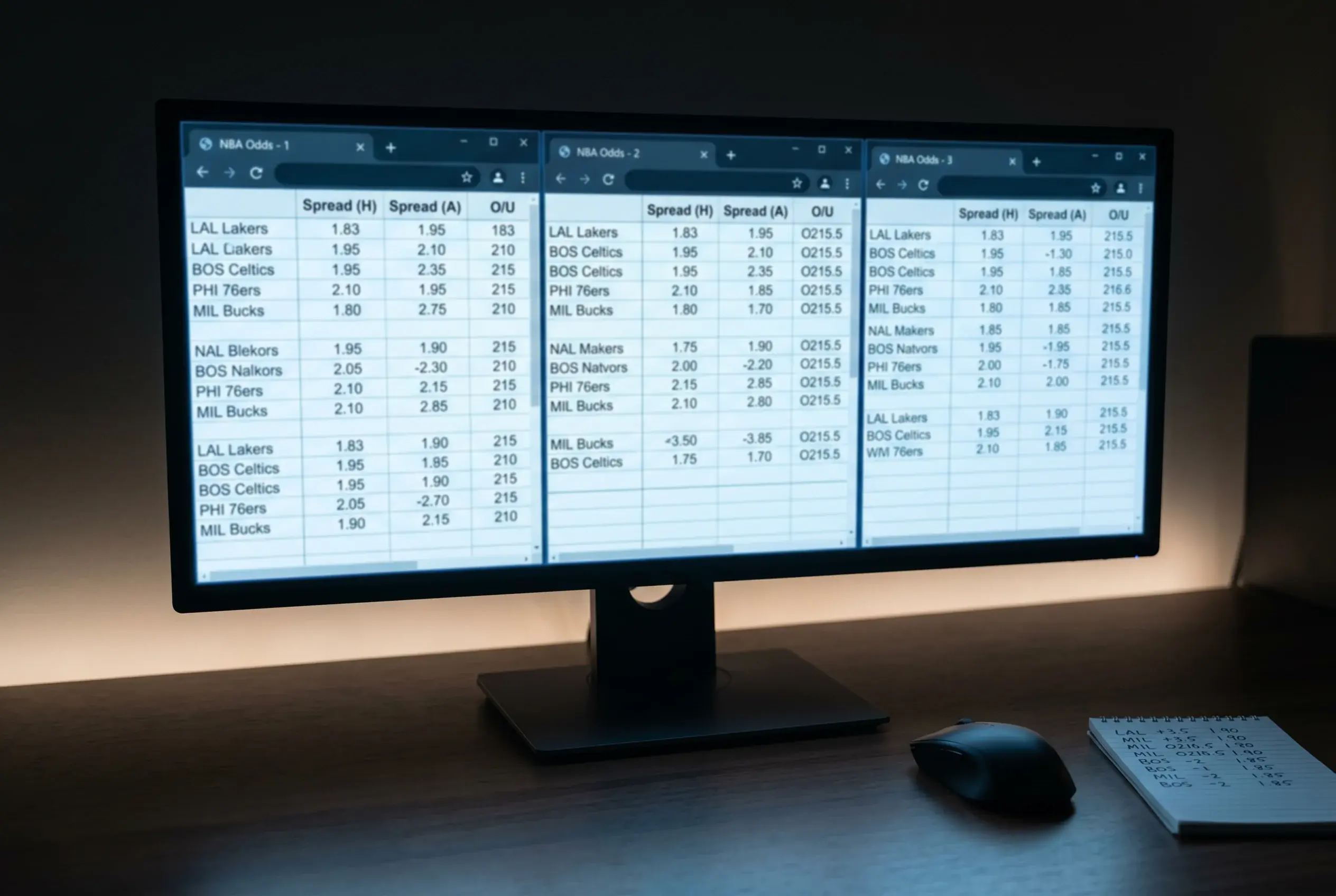
The habit that generates positive CLV is line shopping – checking the same market across multiple UKGC-licensed books before placing your bet. Different books set different prices based on their own exposure, models and customer base. Pinnacle – widely regarded among professionals as the sharpest book for line comparison – provides the benchmark. Analysis from SharpFootballAnalysis estimates that a consistent half-point advantage across 100 bets at standard stakes produces a yield difference of 250 to 500 pounds over the long run.
PaintTheLine NBA Edge Toolkit
Closing line value, schedule/arena context and bankroll survival — the maths behind this playbook, worked with your own numbers.
Log the odds you took and the closing odds. Positive CLV, sustained over 200+ bets, is the strongest long-run skill signal — stronger than short-term win rate.
| Your odds | Closing odds | CLV |
|---|
Recovery maths: how much you need to win back after a drawdown.
Losing-streak probability
I keep three UK-licensed books open in browser tabs on every game night. It takes less than a minute to compare the spread and total across all three before clicking. That minute is the most valuable activity in my entire pre-bet routine.
Bankroll Discipline: The Maths That Outlives a Cold Streak
In February 2023 I went 9-for-11 on NBA spreads over a single weekend. Felt untouchable. The following week I went 3-for-12 and gave back everything plus a chunk of the previous month. What saved me wasn’t willpower – it was a staking system I’d set before the season started and had no discretion to override. Bankroll discipline is the least exciting topic in this playbook and the one most responsible for whether you’re still betting in May or staring at a zeroed balance in January.
The maths is merciless. Lose 20% of your bankroll, entirely normal for a 54% hit rate bettor, and you need a 25% gain to recover. Lose 50% and you need 100%. The only defence is position sizing that keeps individual bet exposure small relative to the total pot.
For most recreational UK punters, flat staking at 1-2% of bankroll per bet is the right approach. It is boring, it feels overly cautious, and it works. I use fractional Kelly (quarter Kelly) on my strongest plays, meaning I never risk more than about 3% on a single game even when the edge looks wide. Everything else gets flat 1.5% units.
Pre-bet bankroll check – run this before every session
- Is this bet within my standard unit size (1-2% of current bankroll)?
- Have I already placed more than 3 bets tonight? If yes, stop and review tomorrow.
- Am I increasing stakes because of a recent loss? If yes, the answer is no.
- Have I checked the line across at least two books?
- Can I articulate a specific reason this game qualifies – rest, injury, HCA, CLV – in one sentence?
- If I lose this bet, will I feel compelled to chase? If yes, reduce the stake by half.
Do
- Set a weekly maximum number of bets (I use 15 for an average NBA week) and stick to it.
- Track every bet in a spreadsheet with the opening line, your line, closing line and stake size.
- Review your results monthly – but focus on CLV and process, not profit/loss.
Don’t
- Increase unit size mid-season because you’re “on a heater.” Variance giveth and variance taketh.
- Use a separate “bonus account” with looser staking rules. Money is fungible.
- Bet on games you haven’t researched just because it’s a big slate and you feel like “something should be on.”
The cold streak will come. It always does. A 54% bettor has roughly a 12% chance of going 4-for-15 or worse in any given 15-bet stretch. That’s not an anomaly; it’s a statistical certainty across an 82-game season. The bankroll system exists so that when it happens, you’re down 8% of your pot instead of 40%, and you can keep betting through it to the other side.
In-Play Betting and Streaming: A UK Bettor’s Edge in EU Time Zones
Most NBA strategy guides are written by Americans for Americans, and they all assume you’re watching the game live on your big screen at 7pm local time with a beer in hand. That’s not your reality. If you’re in the UK, the first tip-off on a full slate is usually around 11pm GMT, and the West Coast games don’t start until 3am or later. Conventional wisdom says that’s a disadvantage. I think it’s the opposite.
The late-night edge – by the time the 1am and 3am games tip off in UK time, American recreational bettors have largely gone to bed or stopped paying attention. The in-play markets for late-slate games tend to be thinner, which means the algorithms adjusting live lines have less liquidity to work with and the corrections are slower. If you’re willing to stay up (or set an alarm), you’re competing against a smaller, more professional pool – and the inefficiencies last longer.
In-play betting on NBA works differently from pre-game because the line adjusts continuously based on score, time and momentum. The pattern I exploit is the overreaction window after a scoring run. When a team goes on a 12-0 run in the second quarter, the live spread overadjusts – but scoring runs in basketball are mean-reverting. The trailing team gets a timeout, adjusts, and typically claws back some deficit. Backing the trailing side during a run-driven overcorrection hits at a notably higher rate than random.
Streaming access matters here because latency is everything. If your video feed is 30 seconds behind the live score data that the bookmaker’s algorithm is using, you’re placing bets on stale information. The delay varies by platform. TNT Sports tends to run a slightly shorter lag than Sky Sports. I test the delay at the start of each session by comparing a live scoring app against the broadcast – if the gap exceeds 15 seconds, I avoid in-play markets for that game entirely.
Quarter betting is a natural fit for in-play from a UK timezone. First-quarter spreads and totals give you a cleanly defined 12-minute window where both teams run starting lineups and garbage time doesn’t exist. The pricing tends to be softer than the full-game market because recreational bettors default to the main line. My most reliable in-play edge sits in first-half totals, where pace data from the opening minutes gives you a real-time read that the pre-game total didn’t capture.
The Rozier Fallout: How NBA Integrity Probes Are Reshaping Prop Markets
In October 2025, the FBI arrested three figures connected to the NBA – Terry Rozier of the Miami Heat, former player and assistant coach Damon Jones, and Portland Trail Blazers head coach Chauncey Billups – on charges related to illegal betting activity. Rozier posted a £3 million bail. The case landed less than 18 months after the Jontay Porter ban for sharing inside information with bettors, and together these scandals have fundamentally altered the prop market landscape in ways that every UK punter needs to understand.
NBA Commissioner Adam Silver has been unequivocal in his public response. “There’s nothing more important than the integrity of the game,” he told media in December 2025. On the Pat McAfee Show earlier that autumn, Silver explained the league’s position in more operational terms: with the regulated structure of legalised betting, the NBA can monitor activity in ways that were unimaginable years ago, tracking exactly where bets are placed and flagging any aberrational behaviour in real time.
Silver also acknowledged the vulnerability that player props introduce. On the same appearance, he noted that it is too easy to manipulate outcomes that seem small and inconsequential – a couple of rebounds, a handful of assists – and that the league is working with betting companies on additional controls. That acknowledgement led to concrete changes: following the Porter case, the NBA asked sportsbook partners to remove under-prop bets on players with two-way contracts, where the financial incentive to manipulate is highest relative to salary.
What changed for UK bettors – several UKGC-licensed books have pulled or restricted under-props on certain player categories. The availability of specific prop types varies by operator, but the overall direction is toward tighter limits, slower market posting and lower maximum stakes on individual player performance bets. Over-props on established starters remain widely available; under-props on fringe roster players are increasingly difficult to find.
The practical impact for your process is twofold. First, if player props were a significant part of your NBA betting, audit what’s still bookable in your preferred UK markets. Points scored for established starters, combined assists-plus-rebounds for All-Star calibre players, and team-level props (total three-pointers made, total turnovers) remain largely untouched. The integrity crackdown has narrowed the prop market. It has not killed it, and the remaining markets are arguably cleaner.
Second, any prop where a single individual can directly influence the outcome is structurally riskier than a team-level market. I’ve shifted my prop activity toward multi-stat categories and game-level aggregates, where manipulation by a single player is far harder to execute. The edge in props was always about usage rate and pace matchups; the integrity reset just forces you to apply that edge to a cleaner subset.
UK Tax, Licensing and Why You Should Stick to UKGC Books
Here’s a fact that still surprises Americans when I mention it at betting conferences: in the United Kingdom, individual punters pay zero tax on gambling winnings. None. Not income tax, not capital gains, not a special betting levy. HMRC’s position is straightforward – gambling winnings are not considered taxable income for individuals, regardless of the amount. This is a genuine structural advantage for UK-based NBA bettors, because it means every penny of your edge hits your pocket rather than being skimmed by the taxman.
The tax sits on the operator, not the punter. UK-licensed bookmakers pay Remote Gaming Duty on their gross gambling yield. As of April 2026, that rate has been hiked from 21% to 40%, a significant increase that operators absorb through their pricing margins. For you as a bettor, the practical implication is that odds at UK books may be fractionally tighter than they were two years ago, but you still keep 100% of your net winnings.
Licensing matters just as much as taxation. According to UKGC data from 44.2 million withdrawal transactions between June and September 2024, 96.3% of payouts were processed automatically, 3.5% within 24 hours and only 0.1% took longer than 48 hours. Those standards are enforced by a regulator that has tripled its criminal case volume year on year.
Andrew Rhodes, the UKGC’s Chief Executive, has described the illegal gambling market in stark terms: “There is nothing more exploitative than the illegal market.” Offshore operators sit outside the consumer protection framework entirely. No fund segregation, no ADR (Alternative Dispute Resolution), no withdrawal standards, no affordability checks. When an offshore book decides not to pay out a winning NBA bet, your recourse is effectively zero.
Do
- Verify that every book you use holds an active UKGC licence – check the register on the Gambling Commission website.
- Keep records of all bets, deposits and withdrawals in a spreadsheet, even though you owe no tax. The data improves your process.
- Use the safer-gambling tools (deposit limits, session timers) that UKGC operators are required to offer.
Don’t
- Chase marginally better odds at unlicensed offshore or crypto-based books. The risk-reward is terrible.
- Assume a “.co.uk” domain means UKGC licensing. Some offshore operators use UK-looking domains without holding a licence.
- Ignore account restriction notices. Approximately 4.31% of accounts are restricted by UK operators for commercial reasons over a 12-month period, and many of those accounts are profitable ones.
The bottom line: betting from a UKGC-licensed account, paying no personal tax and operating under genuine consumer protection is a combination that punters in most other countries don’t have. Use it.
Putting It Together: A Repeatable Pre-Game Routine
Every section above describes a piece of the puzzle. This one is about what happens when you sit down at 10pm on a Thursday, face a 12-game slate and need to decide. Without a routine, you’ll scan the marquee matchup, read a headline and fire off a bet based on vibes. With a routine, you’ll process the slate in 15 minutes and emerge with zero, one or two qualifying bets.
My pre-game routine has evolved over 12 years, but the current version runs in six steps. I do them in this exact order because each step filters the slate further – by the time I reach step six, most games have been eliminated, and the ones that remain have a clear, articulable reason behind them.
The 15-minute pre-game routine
- Step 1: Schedule scan. Check back-to-backs, four-in-fives, road trip tails. Flag rest asymmetries. 90 seconds.
- Step 2: Injury report. Open the official NBA injury report (updated by 5pm ET / 10pm GMT). Note star absences, GTD designations and minutes restrictions.
- Step 3: Home court filter. Check which arena each remaining game is in. Apply your HCA tier (top-5, mid-range, bottom-5).
- Step 4: Line comparison. Compare spreads, totals and moneylines across at least two books. Flag any game where you’re getting a half-point or more versus consensus.
- Step 5: Stake and record. Set the stake at standard unit (1-2% of bankroll). Log the bet with opening line, your line and placement time.
- Step 6: Walk away. Close the tabs. Do not re-check lines after placing. The routine is over.
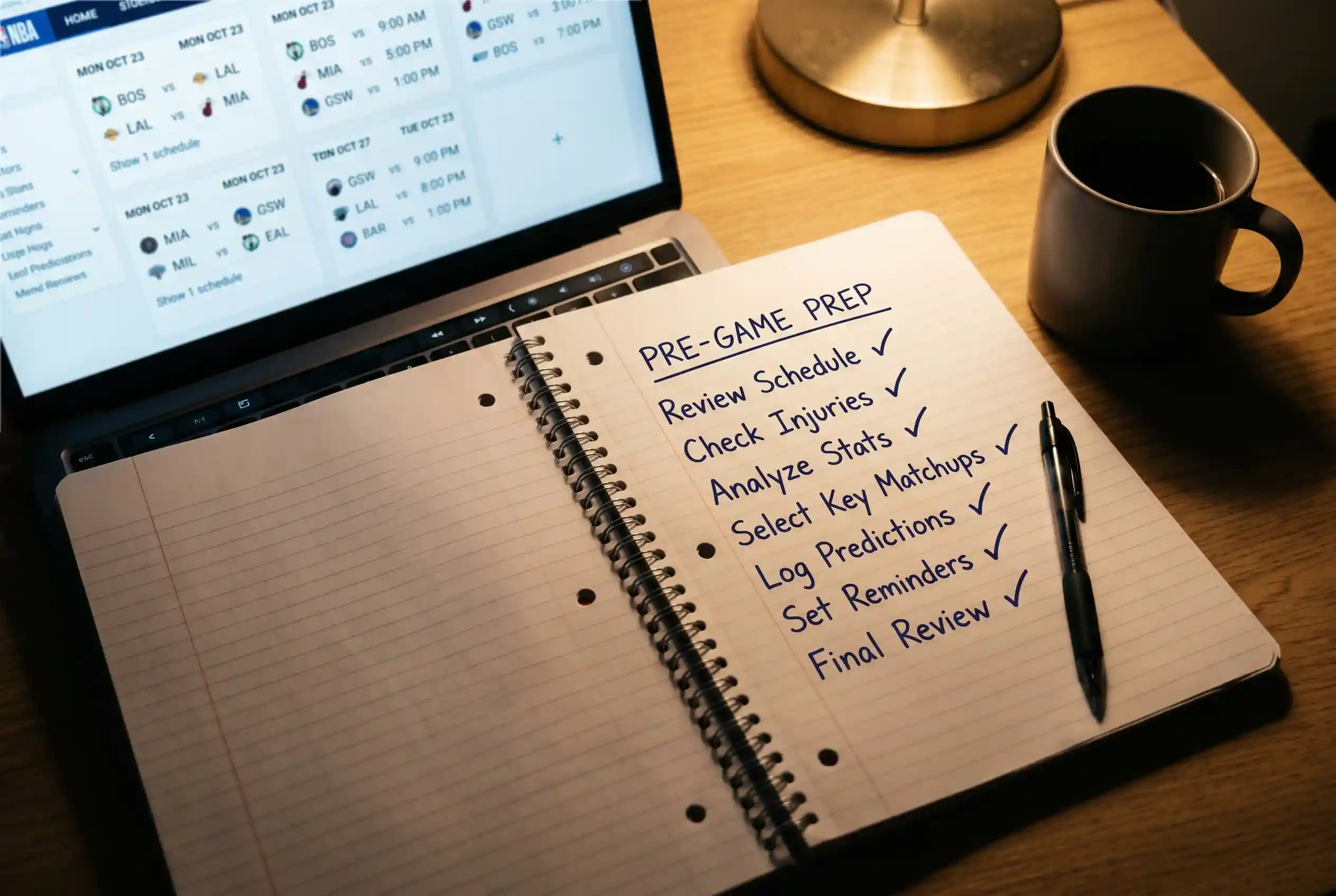
Steps 1 through 3 are filters – they remove games from consideration. Steps 4 and 5 are action steps – they identify and execute value. Step 6 is the hardest one for most people, because the temptation to tinker is enormous. I enforce it by logging off entirely and only checking results the following morning.
The routine is the strategy. No single game, no single angle and no single stat makes you a profitable NBA bettor. The accumulation of small edges, from back-to-back filters to HCA tiers to line shopping to disciplined staking, applied consistently across an 82-game season is what separates winning punters from the rest. Build the routine, trust the process and let the variance sort itself out.
Frequently Asked Questions
What counts as the best NBA betting strategy for a UK punter?
The most reliable approach combines four elements: exploiting schedule-driven edges (back-to-back fatigue, rest asymmetry), line shopping across multiple UKGC-licensed books to capture closing line value, disciplined bankroll management at 1-2% unit stakes, and restricting bets to games where you have a specific reason – not a hunch. The UK adds a structural edge: zero personal tax on winnings and strong consumer protections.
Are NBA betting winnings taxable in the United Kingdom?
No. HMRC does not treat gambling winnings as taxable income for individual punters, regardless of amount or frequency. UK-licensed bookmakers pay Remote Gaming Duty on their gross gambling yield, which rose to 40% in April 2026. You keep 100% of your net winnings.
How do NBA point spreads work at UK bookmakers?
A point spread – called a handicap in UK terminology – assigns a margin of victory the favoured team must cover. If a team is at -5.5, they must win by 6 or more. UK books typically offer spreads in half-point increments at decimal odds around 1.90-1.92 on each side. Your job is to assess whether the margin is correctly priced given rest, injuries, home court and form.
What is closing line value and why does it matter more than win rate?
CLV measures whether you consistently placed bets at better odds than the final price at tip-off. Over hundreds of bets, positive CLV is the most reliable skill indicator because it resists the short-term variance that makes win rate unreliable. A bettor at 51% with consistent +2% CLV is in a stronger long-term position than one at 56% with negative CLV.
Which UK bookmakers offer the strongest NBA markets?
Focus on four criteria rather than brand rankings: market depth (props, alternative lines, quarter markets), pricing margin (under 5% overround on standard spreads is competitive), in-play coverage (streaming and line update speed), and withdrawal speed (96.3% of UK operator withdrawals process automatically per UKGC data). Open at least three UKGC-licensed accounts to enable line shopping.
What does the Terry Rozier case mean for a casual UK punter today?
Several UK books have restricted or removed under-props on two-way contract players and lowered maximum stakes on individual performance markets. Over-props on established starters and multi-stat combinations remain widely available. The takeaway: any prop where a single individual can directly influence the outcome carries higher structural risk. Focus on categories where manipulation is difficult.
Discipline Beats Genius Across an 82-Game Season
Andrew Rhodes described the scale of UK gambling by noting that some 22 and a half million consumers gamble on a regular basis in this country – a significant economic and social activity that continues to be a mass participation exercise. You’re part of that number. The question is whether you participate with an edge or without one.
Everything in this playbook comes back to a single principle: the NBA regular season is 82 games long, and that length is your friend if your process is sound and your enemy if it isn’t. Hot streaks cool. Cold streaks warm. What remains constant is whether you’re consistently finding lines that don’t reflect the true probability – and whether your bankroll can survive the inevitable variance long enough for the maths to play out.
Build the routine. Check the schedule, read the injury report, compare the lines, size the stake and walk away. Do it again tomorrow. The 2025-26 season has given UK punters more data, better tools and a regulatory environment that works in their favour. The only thing it can’t give you is discipline – that part’s on you.
Created by the ”Best nba Betting Strategy” editorial team.